
VOL. 1, NO. 5 -- NOVEMBER/DECEMBER 1999

Live/Works Revisited
By Diane Dorney
 Years
ago you could find an apartment to rent on the main street of Anytown,
U.S.A. It would be located above a shop that was owned by a man with a
name like Sam. Originally Sam lived above the store, but after a few good
years Sam would move out to a frame cottage on the outskirts of town.
Sam would use the rent he collected from you to pay off a loan he had
taken from the local bank to buy the new house. Banks liked lending money
to small business owners like Sam because he provided a service for the
town. He may have sold dry goods, cut hair or owned the local tavern.
Whatever he did, it provided a necessary service to the people who lived
there.
So, what happened to those great buildings that functioned both as places
to live and places to work? No place for them in the post-war suburbs
where buying a beer and clothing now meant a car ride to Ruby Tuesday's
and the mall?
Well, that was then and this is now. Traditional neighborhood planning
has put these multi-functional buildings back on the drawing board. The
hope is that we may, once more, be able to walk or bike to town when it's
time for a haircut. At the same time, millions of home-based workers are
looking for housing that includes both living and working spaces. The
flexible live/work building is looking more and more like the solution
to both.
Paul Brunsell, project director for Middleton Hills, a new traditional
neighborhood development (TND) in Wisconsin sees the advantages of this
concept for the small business owner. "When you can have your residence
and business in one building, it makes these units very affordable,"
said Brunsell.
The Middleton Hills plan has 22 live/work units in the town center. The
first 'stick' of four live/works has just been completed. Three of the
units are already sold. A building construction company, training video
business and hair salon/day spa occupy the commercial spaces.
Brunsell thinks the most appealing aspects of the buildings are in the
intangibles -- less car driving for errands that can be completed in the
town center and less commuting time if you live above your business. And
that adds up to more leisure time. "The public recognized the benefits
right away," he said.
Michel Fontaine is renting a live/work apartment in Riverside, a TND being
developed by Post Properties in Atlanta, Ga. He lives above a dentist's
office and an insurance agency and says he was never concerned with being
above commercial units. In fact, he thinks they have been a successful
addition to the town square. "I go out in the morning, get my café
au lait and a newspaper, walk back home and work for a few hours,"
he said. Later in the day, it's out to the training room, lunch, back
to work, then dinner and drinks at 7. "I do all of this without leaving
the premises! Hard to beat this lifestyle."
Fontaine says living in Riverside allows him to network with potential
customers. "Deals are done at the pool and the River Room bar,"
he said.
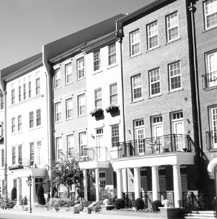
In Kentlands, town architect Mike Watkins built the first of 50 live/works
that will one day line Main Street. He leases out the ground floor to
a realtor and lives in the two floors above. "[This] enabled me to
afford to live in the neighborhood I've worked on for so many years,"
Watkins said. "My tenant loves her 'work' space I lease to her below
my 'live' space." She was sold on the quality and character of the
neighborhood -- I'm sold on the help she provides with the mortgage payment."
Live/work units, like traditional neighborhoods as a whole, are not a
new idea. They are being revisited to provide real solutions to quality
of life issues being debated for the communities of tomorrow. Both put
a new spin on tried and true concepts, bringing them up to date with contemporary
lifestyles.